
Standards
Designed to support standards-aligned controls and audit-ready evidence artifacts
Why standards alignment is difficult for tool-using AI
As orchestration, delegation and tool use expand, governance often becomes narrative-only or retrospective. Standards alignment becomes harder when authority is implicit, transitions are uncontrolled and enforcement is merely advisory at the moment actions become effects.
Our Solution: Control Mapping
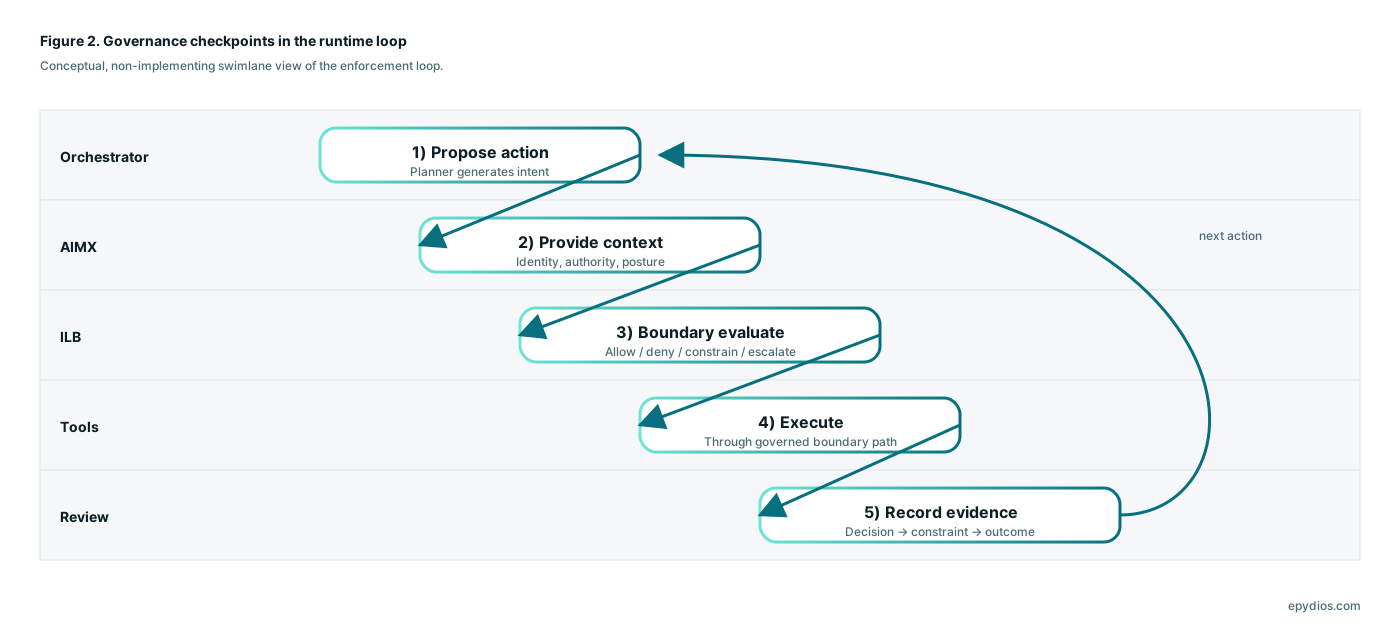
A boundary-first mapping approach:
- Define execution boundary classes in scope, such as data access, outbound actions, privileged writes, transfers and control signals
- Define authority and escalation semantics per boundary class
- Require evidence artifacts sufficient to reconstruct identity, role, authority context, posture, boundary evaluation and execution outcome
The architecture emphasizes explicit identity and authority context at decision time and enforcement anchored at the action boundary.
Evidence expectations
Evidence artifacts are designed to support review and reconstruction. Examples of what an evidence chain may need to support include:
- Who acted and under what role and authority
- What action was proposed and what constraints were applied
- What was allowed, denied or escalated and why
- What executed and what effect occurred
Evidence artifacts are conceptually distinct from logs and are intended to align with audit and incident response needs when deployed.
Standards Certification
This page describes architectural support for standards alignment and evidence production. It is not a compliance claim because compliance depends on deployment scope, implementation details, operational processes and audit outcomes.
The systems are designed to rigorously support robust standard-aligned deployment.
Diligence materials
For diligence discussions, a standards alignment mapping pack can be made available, including a control-ID crosswalk approach and a boundary-class evidence expectations catalog. Availability and scope are context-dependent.
For further discussion contact us.