
Advancing identity-governed autonomy through enforceable execution boundaries
Making governance enforceable where actions become effects
Designed to support standards-aligned controls and audit-ready evidence artifacts
Why this exists
Modern AI systems increasingly act through tools, integrations and agentic workflows. When actions can trigger real-world effects, governance cannot remain advisory or implied. The core problem is not only model behavior. It is also identity drift, authority ambiguity and enforcement that is bypassable at the moment an action becomes an effect.
Epydios is advancing a boundary-first runtime governance architecture that treats identity and authority as explicit, governed runtime state and anchors enforcement at execution interfaces.
Epydios accomplishes this with two core ideas:
- Adaptive Identity Matrix Engine (AIMX)
- Independent Layer Boundary - Behavioral Autonomy Constraint Kernel (ILB; ILB-BACK)
What a governable runtime must provide
Epydios frames five requirements for governable autonomy:
- A stable answer to “who is acting now” through governed identity state
- A stable answer to “under what authority” through explicit authority context
- Controlled transitions for escalation, tightening and revocation rather than implicit drift
- Enforceability at the action boundary where actions become effects
- Evidence artifacts that link context, evaluation and outcome into a reviewable chain
The primitives
Identity and authority
Identity and authority are treated as first-class runtime state, not thin external tokens or informal prompt conventions. The goal is legibility: who is acting, under what role and authority, with what posture.
Execution boundaries
Enforcement is anchored at the interfaces where proposed actions would take effect, such as tool calls, commits, transfers, writes, control signals and other boundary-crossing operations. Governance becomes enforceable when boundaries are explicit and evaluated at decision time.
Evidence artifacts
Evidence artifacts are designed to bind decision to outcome. They are not a promise of compliance. They are categories of records that support review, audit and incident reconstruction.
System at a glance
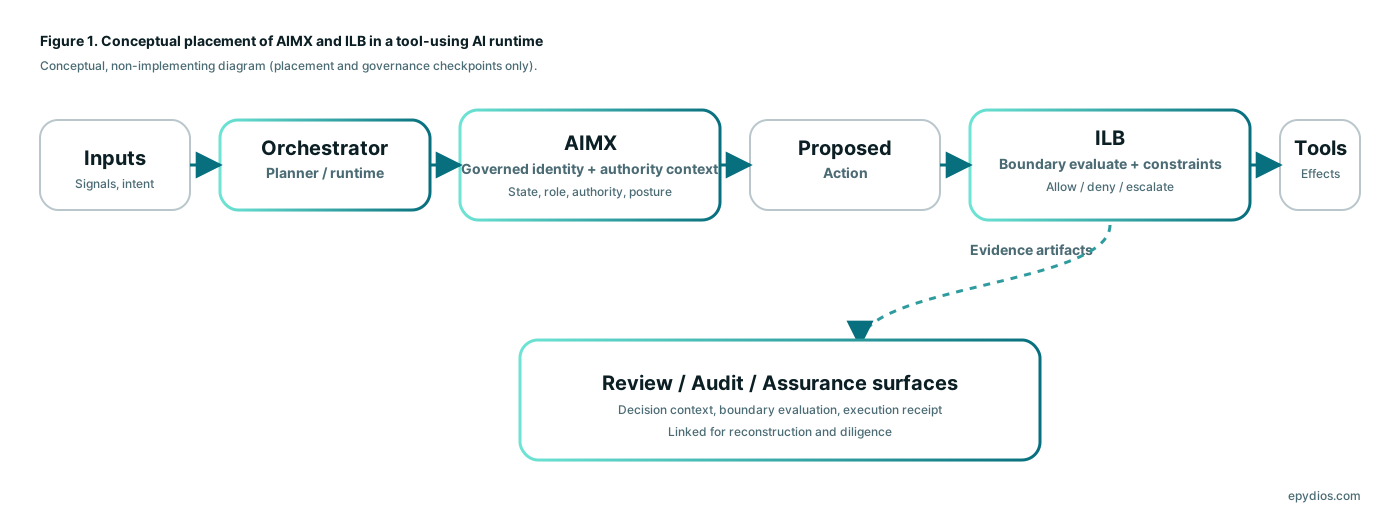
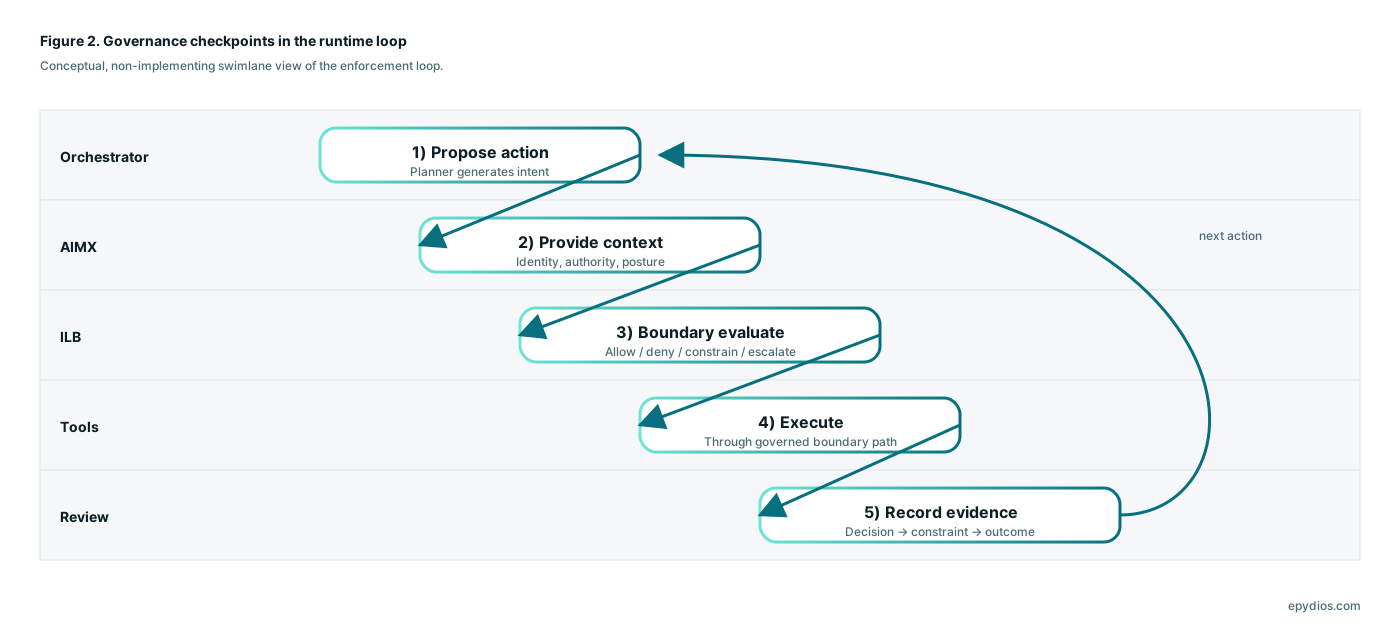
A conceptual loop:
- Orchestrator or planner proposes an action
- Identity and authority context is supplied as governed runtime state
- Boundary evaluation occurs at the execution interface
- The action is allowed with constraints, denied or escalated through controlled posture transitions
- Execution proceeds only through the governed boundary path and produces evidence artifacts
Standards alignment
Epydios is designed to support standards-aligned controls and audit-ready evidence artifacts through control mapping and evidence expectations. Standards alignment here means the architecture supports mapping control objectives to runtime touchpoints and reviewable evidence categories.
Whitepaper
The whitepaper lays out the conceptual model, shared vocabulary, runtime story and scenario illustrations.
Contact
For conceptual feedback, diligence discussions or collaboration inquiries contact us.